
Did you know kids can benefit from more fluoride exposure? Fluoride is a mineral that helps teeth become more resistant to decay (cavities). You can help prevent your child from getting cavities by making sure they drink fluoridated water and brush at least twice daily with fluoridated toothpaste. For many children, this daily fluoride exposure is enough to protect them from new cavities. Request an appointment with our dentists to know more about the benefits of fluoride exposure.
Did you know that brushing your tongue can help in the fight against bad breath?
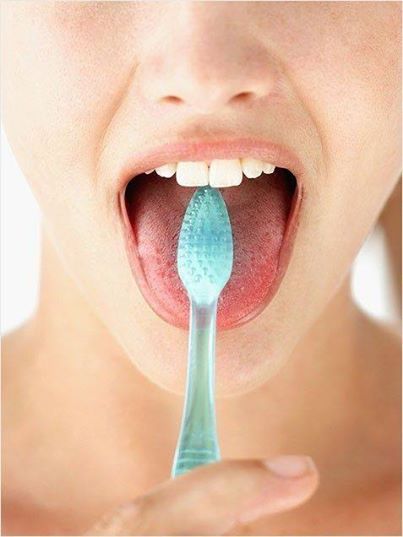
Giving your tongue a gentle brushing removes dead cells, bacteria and food debris which could be a cause of bad breath. Use a soft-bristled toothbrush to mildly brush your tongue everyday after you brush your teeth. Fix an appointment with our dentist and find out more about bad breath prevention.

Symptoms of Temporomandibular joint
Temporomandibular joint (TMJ) and muscle disorders, are a group of conditions that cause pain and dysfunction in the jaw joint and muscles that control jaw movement. The exact cause of this condition is unknown, but has been linked to night grinding and/or clenching, incorrect biting positions and stress. Other symptoms include jaw muscle stiffness; limited movement or locking of the jaw; painful clicking, popping or grating in the jaw joint when opening or closing the mouth; and a change in the way the upper and lower teeth fit together. Fix an appointment at our clinic to learn ways to manage this condition.
What are Dental Sealants?
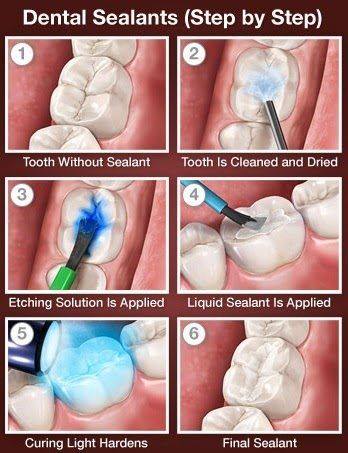
Dental sealants are a thin, plastic coating painted on the chewing surfaces of back teeth (the premolars and molars) to prevent tooth decay. They can protect teeth from decay for a few years, but they need to be checked for chipping or wearing at regular dental check-ups. Fix an appointment at Acharya Dental to get a thorough dental check-up.

Get a crown for your damaged tooth
When a piece of a tooth’s chewing surface breaks off, often around a filling, it is known as a fractured cusp. It rarely damages the pulp, and usually doesn’t cause much pain. But it is best that you get a crown placed over the damaged tooth to protect it to prevent problems in the future. Visit our dental center to get a crown for your damaged tooth.
Did you know that cavities develop faster during the night time than the day?

During the day, the constant movement of the tongue and saliva prevent bacteria from staying in our mouth and causing cavities, whereas during the night time there is very less movement and almost no saliva. While you sleep, the bacteria residing in the mouth feed on the foods present in the mouth and release acids that cause tooth decay. Make an appointment with our dentist to learn more about cavity prevention methods.

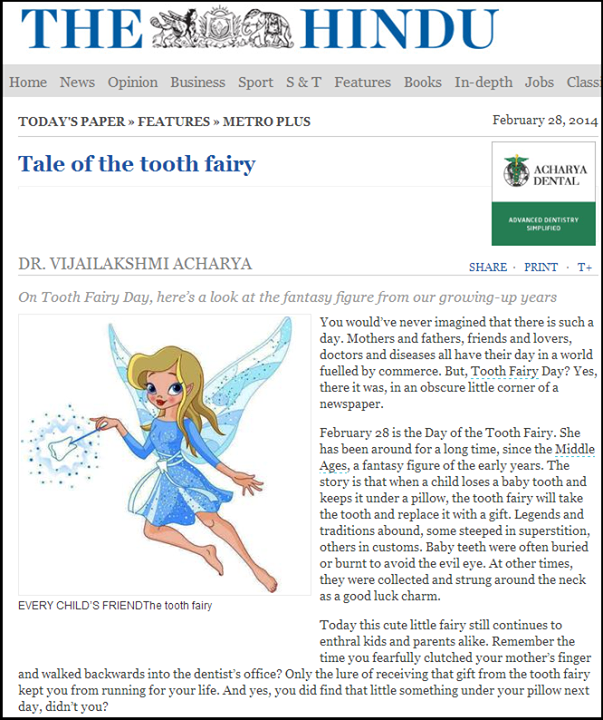
On Tooth Fairy Day
You would’ve never imagined that there is such a day. Mothers and fathers, friends and lovers, doctors and diseases all have their day in a world fuelled by commerce. But, Tooth Fairy Day? Yes, there it was, in an obscure little corner of a newspaper.
Where’s The Toothpick
Picture this: Seated Dinner in an elegant restaurant. The tinkle of glasses, subdued laughter, the rustle of silk. The atmosphere is perfect. The lady in the smart cocktail dress is looking a bit distracted. Her eyes are searching for something that should have been on the table. She finds it at last – a toothpick, fashionably nestled in a silver container. She reaches out her well manicured hand and then covering her mouth politely she starts to pick her teeth……
A business lunch: an important deal has been concluded. Relief is written large on the faces of both parties and its time for the celebrations to begin. The seven course meal includes the salad the succulent chicken tandoori and much more. The meal over, Mr. Successful is restless. Something is stuck between his teeth, and he can’t get it out. He can’t think of anything else either…….not his colleague, the food or the just concluded deal.
What seems a harmless action, at most, a not-so polite thing to do especially in company, could mean a lot more. You would have seen this a countless times, someone picking his teeth.
The toothpick has been around for ages. It is a pretty useful tool, which does what it says. It picks teeth. A rescue tool to remove food. When something gets stuck between your teeth you have an overwhelming desire to remove it. So what, you may say. Now, read on ………
Teeth are placed in a row with their convex surfaces touching and designed such that any food that you chew gets deflected away from the biting surface. As we get older, though the gums start receding, gaps still act as self cleaning areas which ward off particles of food. When the natural design and configuration of the teeth is lost, food accumulation becomes a problem. Thus your need for a toothpick could well be a sign of a more deep seated problem.
The most common cause is a cavity between two teeth. Very often, dental decay attacks the areas between teeth to create a cave-like defect. The top might feel intact but the decay progresses gradually. One of the earliest signs is the problem of food getting lodged, especially those of a fibrous nature.
Gum disease, where a gap occurs because of bacteria collection between the gum and tooth, called a periodontal pocket is another common cause of food impaction. As the disease progresses teeth drift apart, to widen these gaps. Once food starts accumulating here, bacterial activity is intense and there is quick breakdown of the fibres that hold your tooth in place and the bone that support it. This is often accompanied by bleeding.
Frequently, chipped and broken down teeth left unattended end up attracting food particles. At other times, a faulty filling or poorly shaped tooth caps or artificial teeth can cause the accumulation of food particles and bacterial invasion with destruction of teeth. Bad breath often accompanies the situation.
The earliest warning of a decay occurring between teeth could be during a regular checkup. The clinical examination pin points the area and the x-ray confirms the findings. When there is a dental decay the area shows up as a dark spot on the walls of the tooth, as it progresses, it could endanger the nerve of your tooth. Constant lodging of food in the area only hastens the destruction of natural tooth structure. Left alone, you could develop a severe toothache.
At other times, spaces occur due to drifting teeth from an unstable biting pattern or from mild to advanced gum disease.
Some people have grinding and clenching habits. Others have excessive wear of the teeth due to their biting pattern. For still others, ageing results in severe attrition and wearing down of teeth. All these problems cause change in the form and contacts between teeth causing painful food impaction.
Now you have seen the causes.
What about the effects?
Food trapped between teeth, when left behind, takes a long time to breakdown and be digested since they are of a fibrous nature. When degradation takes place, inevitably breakdown of tissue occurs and bacteria start building up. These can make their way into your system and affect heart valves, joints and skin among others.
The solution?
6 monthly dental checkups are the best way to ensure to ensure that there are no cavities, gaps and food traps. Any small cavity can be immediately corrected by a filling, especially in the early stages. Larger gaps may need to be analysed. Gum disease has to be treated and eliminated, followed by space closing options like cast fillings and crowns. Severely worn out teeth may also need crowns. Gaps can also be corrected by orthodontic braces when indicated.
Closing these spaces insures a healthy mouth, free of disease and fresh breath. Food trapped can cause rancid odour. A happy meal with friends and family is the promise that awareness bring you. Scruplous oral hygiene and the use of floss and interdental brushes will ensure healthy teeth that will last you a life time.
So next time, remember…… if you need that toothpick, you need the dentist……….!

Dental Implants
For the average Indian, reading about technological progress is nothing new. He is computer savvy, and surfs the Net for information. In fact, the world has seen that the average Indian is indeed far from average. Advances in medical technology holds even greater interest for our Indian because he knows that the longer he lives, the quality of his life would depend on progress made in this field. Life Sciences, it is accepted, is all about life. Dental technology has also progressed, and is vying for equal attention in a population that is growing older and living longer.
The loss of teeth was seen in the past as a natural progression of aging. Today we know that people lost their teeth due to ignorance, neglect, dental decay, gum disease and sometimes unfortunately through accidents.
Loss of teeth itself is not life threatening, but certainly the quality of life is compromised. No part of the body has a greater role to play than the face. Besides being a focus on our senses, it is the means by which we communicate and reach out to others. The biggest problem that follows disease is loss of function. Equally painful is that which deals with the desire to try. Many times life is completely taken over by the handicap. In addition to difficulty in chewing and enjoying food, there are drastic changes in appearance and speech.
With all or some of these problems there is the inevitable loss of confidence and a subsequent withdrawal from taking interest in the very things that makes life worth living- Food, Love and Laughter.
The need to replace lost teeth has been known since ancient times. As dental science evolved, progress was made gradually from removable loose fitting pieces made out of acrylic to the more sophisticated materials which we see today, metallic frameworks to support denture teeth. This removable prosthesis is at best something to be endured. Nearly everyone can find someone who complains that their dentures are a “problem”. The problem is: they are loose, they move, they hurt, food gets under the denture, only soft chewing is possible and they are difficult to clean. Fixed bridges which are used when the missing teeth are just a few are an alternative except that adjacent teeth have to be shaped and reduced to provide a fixed solution.
Dental Implantology is the science that has developed as an answer for the great need to have artificial or replacement teeth anchored firmly in position. The Oxford dictionary describes the implant as “an insert in a living body” Imagine inserting a support for a lost tooth in a jaw forever. The science has progressed greatly in the past fifty years since it was first introduced. It is a safe and predictable technology for an idea whose time has come. Today’s dental implants come in various designs and surfaces in order to achieve the best possible anchorage in the jawbone.
Look at this discovery: the metal Titanium integrates with human tissue thus making it possible for the metal to act as the root that can support new fixed teeth into position. This is as close to nature as one can possibly get. Once the concept of dental implants is understood, it does not seem to be overwhelming. Titanium tooth roots can be used to replace all or some of the missing teeth. Some or all teeth can be implanted. This is done in a clinic setting with local anaesthesia. It usually does not need hospitalization.
Further, computer technology has made inroads in the progress of implant placement accurately and safely. Impressions of the area to be implanted are scanned to create a template which guides the dentist into placing the implants. In many cases, provisional teeth can be immediately placed over the implants at the time of fixing them.
Treatment steps:
- The first step is to place the Titanium implants. These implants will remain covered for approximately 3-6 months. During this time, the implants fuse to the bone. If the implants gets anchored very well in some cases an immediate provisional teeth can be fixed at the same time. This is particularly useful when front teeth are being replaced.
- Involves uncovering the implant and attaching a pillar to each implant which will serve as the foundation on which the teeth will be placed.
- Placement of the new teeth to suit individual needs to provide a natural appearance.
Teeth over these implants can be either fixed or removable depending on the individual needs. In both instances, the teeth will be fixed securely so as to enjoy everyday life without worry. It is also possible to permanently anchor small sections of missing teeth either in the front or the back.
One question looms large. How expensive is it?
There are many options tailored to suit individual needs. Consumers are cautioned on the availability of cheap implants, sometimes indigenously manufactured, which have not been properly safety certified or documented for long term success. It is better to go in for reputed brands with a track record. The initial expenses may be marginally higher but the benefits far outweigh the costs. Your dentist can appraise you of all these.
To some people implants may sound cold and clinical. Scientific precision and advanced technology are however only the tools which touch the life of humans. From the tiny electronic chip to the man on the moon, somewhere in between is the dental implant seeking to give people a better life and making a bid for posterity as the single most significant dental advance in the past 200 years.
The time taken and the process is well worth it all.

Stop Smoking
Every smoker should know Christopher Columbus. He was the man who discovered tobacco and introduced it to the world. Every smoker should also know about the impact of smoking on his oral health. Recent studies have been disturbing. So far you have heard every physician patiently telling you to cut down or give up smoking because “It is bad for your health”. You stifle a yawn, you have heard it all too often.
Here is the doctor’s file on the effects of smoking.
Cigarette smoking is related to lung cancer, cancer of the gullet and bladder. Cigarette smoking is the most important cause of chronic bronchitis. Smokers have a higher death rate from heart disease than non-smokers. Pipe smoking seems related to lip cancer. As if all this were not enough to set the alarm bells ringing the dentist has now stepped into the picture with revelations about smoking and oral health. Yes, you guessed right – smoking is bad for the teeth as well. It is usual for the dentist to warn patients about the risk of getting white patches in the mouth that could lead to oral cancer. In every day practice, however, what dentists really see most frequently are the major consequences of smoking and gum disease.
Studies done in the 1970s showed that the effects of smoking or gum diseases were not so serious and were mostly due to poor oral hygiene in general among smokers. A decade later in the 1980s with increasingly sophisticated methods, it was found that smoking had a direct independent association with gum diseases.
Researches found that smoking caused a greater loss in the bone that supports the teeth. In smokers teeth got looser faster and there is greater incidence of receding gums.
In a very recent study these early studies have been categorically proved beyond doubt. What happens and how:
In smokers more bone is lost with more smoking. The tooth supporting fibres and bone are affected but ht effect seems to be not local as one would imagine but by a systemic influence by altering the response of the root to disease. Even gum treatments are not very successful because of this altered response. Exposing the mouth to years of tobacco use causes gum disease, cavities of the tooth surface and root surface and subsequent tooth loss. Smokers generally have reduced saliva that is, the mouth is generally dry. This dryness allows plaque and bacteria to adhere to the teeth better and thus sets the stage the disease.
Research suggests that smoking has a biologic effect on bone tissue and may be the cause of decreased calcium absorption. In effect in ageing smokers the mineral content of bone is reduced. Looked at objectivity, it is not surprising that smoking has such a devastating effect on oral tissues. With every puff a smoker inhales 2-4,000 chemicals in each 50mg inhalation.
Just look at the list of smoking associated oral diseases.
- Loss of appetite
- Delayed would healing
- Smokers palate (black patches on palate)
- Gum disease
- Bad breath
- Stains on teeth
- Altered taste and smell
- Dental caries
- White patches in mouth (leukoplakia)
- Chronical fungal infections
- Birth defects
- Oral cancer
A dozen problems. Life is complicated as it is. Why complicate it further? Your sanity and your teeth are at stake. Why not give up smoking today?