
Blog Media

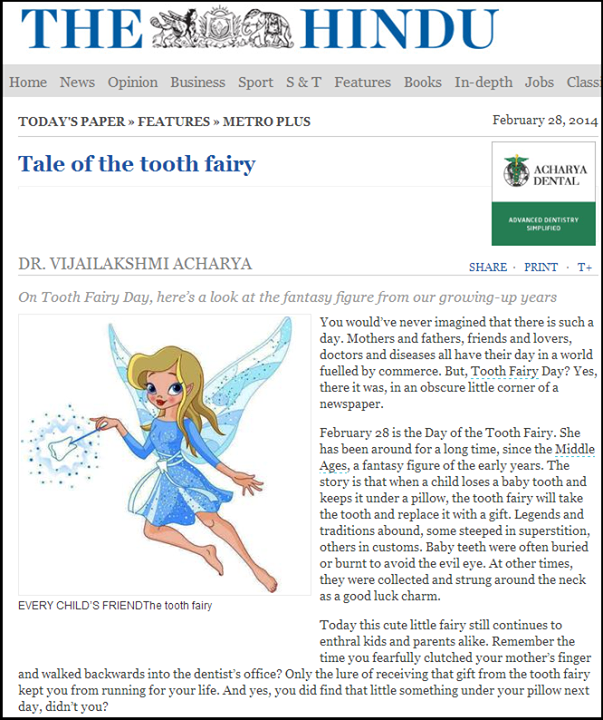
On Tooth Fairy Day

You would’ve never imagined that there is such a day. Mothers and fathers, friends and lovers, doctors and diseases all have their day in a world fuelled by commerce. But, Tooth Fairy Day? Yes, there it was, in an obscure little corner of a newspaper.
1625625_609691369103809_914214978_n

Blog Pain Management

Where’s The Toothpick

Picture this: Seated Dinner in an elegant restaurant. The tinkle of glasses, subdued laughter, the rustle of silk. The atmosphere is perfect. The lady in the smart cocktail dress is looking a bit distracted. Her eyes are searching for something that should have been on the table. She finds it at last – a toothpick, fashionably nestled in a silver container. She reaches out her well manicured hand and then covering her mouth politely she starts to pick her teeth……

A business lunch: an important deal has been concluded. Relief is written large on the faces of both parties and its time for the celebrations to begin. The seven course meal includes the salad the succulent chicken tandoori and much more. The meal over, Mr. Successful is restless. Something is stuck between his teeth, and he can’t get it out. He can’t think of anything else either…….not his colleague, the food or the just concluded deal.
What seems a harmless action, at most, a not-so polite thing to do especially in company, could mean a lot more. You would have seen this a countless times, someone picking his teeth.

The toothpick has been around for ages. It is a pretty useful tool, which does what it says. It picks teeth. A rescue tool to remove food. When something gets stuck between your teeth you have an overwhelming desire to remove it. So what, you may say. Now, read on ………

Teeth are placed in a row with their convex surfaces touching and designed such that any food that you chew gets deflected away from the biting surface. As we get older, though the gums start receding, gaps still act as self cleaning areas which ward off particles of food. When the natural design and configuration of the teeth is lost, food accumulation becomes a problem. Thus your need for a toothpick could well be a sign of a more deep seated problem.

The most common cause is a cavity between two teeth. Very often, dental decay attacks the areas between teeth to create a cave-like defect. The top might feel intact but the decay progresses gradually. One of the earliest signs is the problem of food getting lodged, especially those of a fibrous nature.

Gum disease, where a gap occurs because of bacteria collection between the gum and tooth, called a periodontal pocket is another common cause of food impaction. As the disease progresses teeth drift apart, to widen these gaps. Once food starts accumulating here, bacterial activity is intense and there is quick breakdown of the fibres that hold your tooth in place and the bone that support it. This is often accompanied by bleeding.
Frequently, chipped and broken down teeth left unattended end up attracting food particles. At other times, a faulty filling or poorly shaped tooth caps or artificial teeth can cause the accumulation of food particles and bacterial invasion with destruction of teeth. Bad breath often accompanies the situation.

The earliest warning of a decay occurring between teeth could be during a regular checkup. The clinical examination pin points the area and the x-ray confirms the findings. When there is a dental decay the area shows up as a dark spot on the walls of the tooth, as it progresses, it could endanger the nerve of your tooth. Constant lodging of food in the area only hastens the destruction of natural tooth structure. Left alone, you could develop a severe toothache.
At other times, spaces occur due to drifting teeth from an unstable biting pattern or from mild to advanced gum disease.

Some people have grinding and clenching habits. Others have excessive wear of the teeth due to their biting pattern. For still others, ageing results in severe attrition and wearing down of teeth. All these problems cause change in the form and contacts between teeth causing painful food impaction.

Now you have seen the causes.

What about the effects?
Food trapped between teeth, when left behind, takes a long time to breakdown and be digested since they are of a fibrous nature. When degradation takes place, inevitably breakdown of tissue occurs and bacteria start building up. These can make their way into your system and affect heart valves, joints and skin among others.
The solution?

6 monthly dental checkups are the best way to ensure to ensure that there are no cavities, gaps and food traps. Any small cavity can be immediately corrected by a filling, especially in the early stages. Larger gaps may need to be analysed. Gum disease has to be treated and eliminated, followed by space closing options like cast fillings and crowns. Severely worn out teeth may also need crowns. Gaps can also be corrected by orthodontic braces when indicated.

Closing these spaces insures a healthy mouth, free of disease and fresh breath. Food trapped can cause rancid odour. A happy meal with friends and family is the promise that awareness bring you. Scruplous oral hygiene and the use of floss and interdental brushes will ensure healthy teeth that will last you a life time.
So next time, remember…… if you need that toothpick, you need the dentist……….!

Blog Dental Implants

Dental Implants

For the average Indian, reading about technological progress is nothing new. He is computer savvy, and surfs the Net for information. In fact, the world has seen that the average Indian is indeed far from average. Advances in medical technology holds even greater interest for our Indian because he knows that the longer he lives, the quality of his life would depend on progress made in this field. Life Sciences, it is accepted, is all about life. Dental technology has also progressed, and is vying for equal attention in a population that is growing older and living longer.

The loss of teeth was seen in the past as a natural progression of aging. Today we know that people lost their teeth due to ignorance, neglect, dental decay, gum disease and sometimes unfortunately through accidents.

Loss of teeth itself is not life threatening, but certainly the quality of life is compromised. No part of the body has a greater role to play than the face. Besides being a focus on our senses, it is the means by which we communicate and reach out to others. The biggest problem that follows disease is loss of function. Equally painful is that which deals with the desire to try. Many times life is completely taken over by the handicap. In addition to difficulty in chewing and enjoying food, there are drastic changes in appearance and speech.

With all or some of these problems there is the inevitable loss of confidence and a subsequent withdrawal from taking interest in the very things that makes life worth living- Food, Love and Laughter.

The need to replace lost teeth has been known since ancient times. As dental science evolved, progress was made gradually from removable loose fitting pieces made out of acrylic to the more sophisticated materials which we see today, metallic frameworks to support denture teeth. This removable prosthesis is at best something to be endured. Nearly everyone can find someone who complains that their dentures are a “problem”. The problem is: they are loose, they move, they hurt, food gets under the denture, only soft chewing is possible and they are difficult to clean. Fixed bridges which are used when the missing teeth are just a few are an alternative except that adjacent teeth have to be shaped and reduced to provide a fixed solution.

Dental Implantology is the science that has developed as an answer for the great need to have artificial or replacement teeth anchored firmly in position. The Oxford dictionary describes the implant as “an insert in a living body” Imagine inserting a support for a lost tooth in a jaw forever. The science has progressed greatly in the past fifty years since it was first introduced. It is a safe and predictable technology for an idea whose time has come. Today’s dental implants come in various designs and surfaces in order to achieve the best possible anchorage in the jawbone.

Look at this discovery: the metal Titanium integrates with human tissue thus making it possible for the metal to act as the root that can support new fixed teeth into position. This is as close to nature as one can possibly get. Once the concept of dental implants is understood, it does not seem to be overwhelming. Titanium tooth roots can be used to replace all or some of the missing teeth. Some or all teeth can be implanted. This is done in a clinic setting with local anaesthesia. It usually does not need hospitalization.

Further, computer technology has made inroads in the progress of implant placement accurately and safely. Impressions of the area to be implanted are scanned to create a template which guides the dentist into placing the implants. In many cases, provisional teeth can be immediately placed over the implants at the time of fixing them.

Treatment steps:

  • The first step is to place the Titanium implants. These implants will remain covered for approximately 3-6 months. During this time, the implants fuse to the bone. If the implants gets anchored very well in some cases an immediate provisional teeth can be fixed at the same time. This is particularly useful when front teeth are being replaced.
  • Involves uncovering the implant and attaching a pillar to each implant which will serve as the foundation on which the teeth will be placed.
  • Placement of the new teeth to suit individual needs to provide a natural appearance.

Teeth over these implants can be either fixed or removable depending on the individual needs. In both instances, the teeth will be fixed securely so as to enjoy everyday life without worry. It is also possible to permanently anchor small sections of missing teeth either in the front or the back.

One question looms large. How expensive is it? 
There are many options tailored to suit individual needs. Consumers are cautioned on the availability of cheap implants, sometimes indigenously manufactured, which have not been properly safety certified or documented for long term success. It is better to go in for reputed brands with a track record. The initial expenses may be marginally higher but the benefits far outweigh the costs. Your dentist can appraise you of all these.

To some people implants may sound cold and clinical. Scientific precision and advanced technology are however only the tools which touch the life of humans. From the tiny electronic chip to the man on the moon, somewhere in between is the dental implant seeking to give people a better life and making a bid for posterity as the single most significant dental advance in the past 200 years.

The time taken and the process is well worth it all.

Blog No Smoking

Stop Smoking

Every smoker should know Christopher Columbus. He was the man who discovered tobacco and introduced it to the world. Every smoker should also know about the impact of smoking on his oral health. Recent studies have been disturbing. So far you have heard every physician patiently telling you to cut down or give up smoking because “It is bad for your health”. You stifle a yawn, you have heard it all too often.

Here is the doctor’s file on the effects of smoking. 
Cigarette smoking is related to lung cancer, cancer of the gullet and bladder. Cigarette smoking is the most important cause of chronic bronchitis. Smokers have a higher death rate from heart disease than non-smokers. Pipe smoking seems related to lip cancer. As if all this were not enough to set the alarm bells ringing the dentist has now stepped into the picture with revelations about smoking and oral health. Yes, you guessed right – smoking is bad for the teeth as well. It is usual for the dentist to warn patients about the risk of getting white patches in the mouth that could lead to oral cancer. In every day practice, however, what dentists really see most frequently are the major consequences of smoking and gum disease.

Studies done in the 1970s showed that the effects of smoking or gum diseases were not so serious and were mostly due to poor oral hygiene in general among smokers. A decade later in the 1980s with increasingly sophisticated methods, it was found that smoking had a direct independent association with gum diseases.
Researches found that smoking caused a greater loss in the bone that supports the teeth. In smokers teeth got looser faster and there is greater incidence of receding gums.

In a very recent study these early studies have been categorically proved beyond doubt. What happens and how:
In smokers more bone is lost with more smoking. The tooth supporting fibres and bone are affected but ht effect seems to be not local as one would imagine but by a systemic influence by altering the response of the root to disease. Even gum treatments are not very successful because of this altered response. Exposing the mouth to years of tobacco use causes gum disease, cavities of the tooth surface and root surface and subsequent tooth loss. Smokers generally have reduced saliva that is, the mouth is generally dry. This dryness allows plaque and bacteria to adhere to the teeth better and thus sets the stage the disease.

Research suggests that smoking has a biologic effect on bone tissue and may be the cause of decreased calcium absorption. In effect in ageing smokers the mineral content of bone is reduced. Looked at objectivity, it is not surprising that smoking has such a devastating effect on oral tissues. With every puff a smoker inhales 2-4,000 chemicals in each 50mg inhalation.

Just look at the list of smoking associated oral diseases.

  • Loss of appetite
  • Delayed would healing
  • Smokers palate (black patches on palate)
  • Gum disease
  • Bad breath
  • Stains on teeth
  • Altered taste and smell
  • Dental caries
  • White patches in mouth (leukoplakia)
  • Chronical fungal infections
  • Birth defects
  • Oral cancer

A dozen problems. Life is complicated as it is. Why complicate it further? Your sanity and your teeth are at stake. Why not give up smoking today?

Blog Teeth Whitening

Smile Makeover – Are You Ready?

Your smile is usually the first thing people notice about you. Your expression defines what sort of person you are and is a pointer to the state of your health. A brilliant smile can ignite a room and make a thousand hearts flutter.

A recent survey showed that 45% of people judged other people by the look of their smile and 75% of people were not confident to smile for a photograph.

You could have one or more of the following problems:

  • Discoloured or stained teeth
  • Chipped or broken or worn teeth
  • Crooked or overlapping teeth
  • Gaps or Missing teeth which can change your speech and smile line
  • Metallic fillings causing your teeth to look old and grey
  • A Gummy smile ie. Your gums show when you smile

What is good to know is that no matter what the problem with your smile there’s a way to make it look stunning.

Yes, with a smile makeover you can get an amazing smile. But what is it and what does it take to get there?

A “Smile Makeover” refers to a combination of esthetic dental procedures that enhances the beauty and appearance of the smile, at the same time maintaining the harmony of Nature.

Therefore you may need a combination of procedures to achieve that special look. Here is a shortlist of problems and their solutions:

  • Discoloured or stained teeth or metallic fillings can be corrected with composite fillings and tooth whitening
  • Chipped or broken or worn teeth can be solved with bonding and veneers
  • Crooked or overlapping teeth can be corrected either by braces or veneers
  • Gaps can be closed with resin fillings, veneers and braces
  • Gummy smiles are corrected with laser gum contouring

The first step is a total examination by a cosmetic dentist. The “style” of your smile should be visualized, discussed and planned. It is to be determined if you need one or more procedures.

The possibilities are endless. Imagine, in a short time you can have a makeover that enhances the beauty of your smile, correcting almost any problem. Even the most extreme procedures can be completed in 3-4 easy visits.

The end result? – a younger looking, more confident you, ready to take on the world!

Blog No Smoking

Put That Cigarette Down

It is simply not worth the bother. Do not delude yourself that a cigarette in hand will win you admiring looks. Puffing away is neither hep nor healthy.

In high school, our group of friends was the most closely knit and the best known group of five, admired by the juniors and acknowledged by the teachers. We did very well academically. Vivek, Abdul, Albert, Akshay and me. The formidable five. No one said it openly but we competed to be at the top, to get the best grades, wear the best clothes and be the most popular. Money was never lacking. Someone would always provide. After all, our folks had enough to spare. We were all equal on the face of it, but wait. There was me. Not very tall, 5.5” in my socks. I had a problem making new friends and meeting people. Heck, I was too shy. Vivek, who was the unelected group leader, looked great. His hair was naturally wavy and when he flicked back that arrogant lock which hovered over those grey-green eyes. God, he looked good. Some guys had all the luck.

Since last month he had further added to his charisma-a cigarette had appeared between his fingers. The overall picture was just toot much for the girls to resist. How I wished I could adopt that casual air of nonchalance. I was dejected. Then one day, Vivek called me to the cigarette. Me and a fag? That was too much. What would the old man say? But wait, he did not have to know. I ran home to see how I looked. The mirror in the bathroom never told a lie. The cigarette looked great, no, – I looked like I had class. I was pleased. Tomorrow, New Year’s eve and what and effect I would create on the crowd.

That was the summer when I had just turned 15. I have never looked back since then. Until now. That desperate need for recognition and acceptance translated into adult behavior. Tobacco was my constant companion – my support when I was lonely. My constant companion to share my happy moments with – my everything.
I am 45 now. The other day I noticed a small white patch on the inside of my left cheek. There was no pain, it only felt a little thickened, a bit rough. There was also less feeling in that area. The other funny thing was that when I wanted to put that pani-puri into my mouth, I found I could not open my mouth wide. Hey, what’s going on? I decided to go to a dentist. Here is what he told me.

White patches may be one of the earliest signs of cancer of the mouth. Oral cancer is about four times more common in tobacco users that those who do not smoke or chew tobacco. Smokers are also at great risk of gum disease where the supporting fibres and bones of the teeth are destroyed and cause loosening of the teeth. In fact this problem is more common than cancer. In smokers the amount of bone loss increases with smoking. Smoking exerts mainly a system of influence and affects the tooth supporting structures by interfering with the body (root) response system. Also smokers are at great risk of tooth decay. Treatment for controlling existing gum disease also holds out less chance of healing with people who smoke.

The possible method by which smoking affects dental health is not clear. There are 2000 to 4000 chemicals in each 50mg inhalation of material a smoker inhales with every puff.

Tobacco smoking or chewing – is definite self-destructive behavior. Look at all that you stand to lose – your peace, your health, your sanity and your teeth.

Blog Laser Dentistry

Laser Dentistry

Fear is a common feeling for most people while they wait in the dentist’s office. All those magazines and music just can’t get your mind off those whirring noises. If the thought of that drill operating anywhere in your mouth gives you the chills or a cold sweat then maybe it’s time to investigate laser dentistry.

Traditional dentistry requires the use of a rotary tool that has many useful attachments. Among these are cleaning brushes, drills and sanding heads. All of them require rough physical contact that can leave you nauseous and stressed out. Most of them also require water and suction to help clear out the associated by-products.

Laser dentistry eliminates many of the common complaints of traditional dentistry. A laser device replaces the rotary tool and can be used for everything from surgery to tooth bleaching. The only addition to the procedure is the requirement of protective glasses to shield the eyes from the laser beam. A laser doesn’t make any noise and doesn’t require physical contact with your teeth. Water isn’t usually needed but air suction is used to keep the treated area cool.

The time span of a laser treatment can vary depending on the usage. Some treatments with the laser may only last a few moments, while others could last minutes. When it comes to surgery, laser dentistry offers several significant improvements. There’s not a big need for anaesthesia. Bleeding and swelling are reduced and there’s not much discomfort afterwards. For tooth bleaching, a laser can speed up and enhance the action of the bleaching agents. Natural-looking fillings for cavities can be cured in minutes and patients can eat immediately afterwards. The benefits of laser dentistry are numerous and exciting!

Lasers can be tuned to affect different parts of the mouth. The enamel of your teeth, your gums and whitening agents all react to different wavelengths of light. By tuning the laser to a specific task, the dentist can target a problem without causing other ones to crop up.

Laser dentistry doesn’t require a whole lot of additional training. Most dentists find it is an affordable alternative for people who are afraid of drills. Though the cost of the equipment and training must eventually be passed on to the patient, people who want laser dentistry seldom mind.

Consult a dentist who offers laser techniques today to discuss your options. Depending on what sort of treatment you require, there should exist some form of laser dentistry that can address your needs.

Blog Teeth Whitening

Elvis Presley’s Tooth – For Sale!

Welcome to the mad, mad world of memorabilia. We all know die-hard fans collect anything that they can lay their hands on- ties and tees, used perfume, peeling photographs, you name it, they want it. Here’s the ultimate. Elvis Presley of the “Wooden Heart” now has his tooth in a box waiting to be sold, along with a lock of his hair- on e-Bay for 100,000US$!

It got me thinking-what was a tooth worth, anyway? The value of teeth and the role they play in our health and wellbeing are known unfortunately, only after they are lost.

Teeth can be lost due to severe physical trauma like in an accident. More commonly, loss occurs from tooth decay that cannot be restored, fracture and loss of supporting bone or from untreatable infection.

It is unwise to leave an empty space. The entire setup is balanced very dynamically and one missing component can have damaging effects such as:

  • Shifting, tipping of the remaining teeth into empty space
  • Gaps open up to attract food particle that causes decay and gum disease
  • Bite collapse- the jaw closes farther than it should because of lack of support
  • An increased chance of Root Canals or increased bone loss due to more force on the remaining teeth
  • The longer missing teeth are replaced, the more complex the treatment may become.

Modern dentistry offers the following Tooth replacement options:
Full Dentures:
Dentures are made of either acrylic or metal. They are essentially artificial teeth set in to a framework, which sits on the gums and takes support from the remaining natural teeth.

Partial Dentures:
Partial dentures are used when many teeth are missing and when teeth are not strong enough to support a bridge. Complete dentures are used when all upper and lower teeth are missing.

The disadvantages of these removable pieces in the mouth include inability to speak freely, chew effectively and look good. They have to be removed after every meal and Yes, you can lose it or break it at a most inconvenient moment.

Bridge:
It is term used when the missing tooth is replaced with an artificial tooth that is cemented to the adjoining natural teeth. Most commonly the adjacent teeth are shaped to receive crowns and these are connected to form the bridge. They are useful when only for a few missing teeth. They are firmly fixed and therefore efficient. However, Bridges need the preparation of the adjacent natural teeth involving long hours in the chair and are difficult to clean. In the long run the adjacent teeth also develop problems.

Implants:
Artificial tooth supports surgically set in the jaw – are used in combination with bridges, dentures and crowns to replace any number of missing teeth. Adults who have healthy gums, adequate bone to support the implant, and a commitment to meticulous oral hygiene are good candidates for the procedure. Implants require one or two outpatient or office surgeries and take from three to nine months to complete. Implants are used to replace a single, multiple or all teeth that may be missing.

When a person has a tooth problem, the easiest thing to do seems to be to pull out the tooth and get rid of the problem. It is indeed a pity that you can pull out your tooth for a few rupees and it can cost you a lot of money and time to replace them. Dentists can give you only a reasonable replacement for a perfect work of Nature. Spending time on preventive dentistry is the single most effective way of preserving your precious teeth for a lifetime. These include regular check-ups and professional advice and prophylaxis. Your tooth may not be Elvis’ tooth but it is far more valuable, especially to you. Take care of this precious asset and it will serve you for a lifetime of good health and quality living.

Blog Cosmetic Dentistry

Cosmetic Dentistry And You

Browsing through a book titled ‘Beauty through the Ages’, I was bemused to see that the concept of beauty has changed so radically. Well Oiled hair, kohl darkened eyes and a buxom figure was the rage of yesteryear, today beauty wears a bold look laced with abandon. Now beauty deals with such intangibles as Attitude and Style. Yes, a lot has changed except for one thing.

From Marilyn Monroe to Madhuri Dixit, Robert Redford to Rajesh Khanna, the value of the smile is unchanged. These famous smiles have fired the imagination of the masses and launched a thousand sighs.

Yes, a beautiful smile lights up the face, helps you on your route to success and makes you feel good. A beautiful smile is not just for the rich and the famous. It’s for all of us. We all want to look good and feel confident.

Cosmetic Dentistry has evolved into a multi-disciplinary component of total facial harmony. Facial harmony applies to all the facial muscles around the mouth, the gums and the teeth. All of these together create an optimal smile and is part of the complete look.

Dentistry has met this challenge with an array of new materials and innovative techniques. These can change your smile and your life, forever. Here is brief overview of what is possible.

Cosmetic contouring:
Tooth reshaping, or contouring, is one of few instant treatments now available in cosmetic dentistry. Dental reshaping and contouring is a procedure to correct crooked teeth, chipped teeth, cracked teeth or even overlapping teeth in just one session. The dental contouring procedure can even be a substitute for braces under certain circumstances. It is also a procedure of subtle changes. Tooth reshaping, or dental contouring, is commonly used to alter the length, shape or position of your teeth.

Bonding:
Bonding is done with composite resins to close gaps to fix chipped teeth, to cover discolourations and to replace the traditional silver fillings in the back teeth.

Inlays/Onlays:
This is a highly esthetic, non-metallic restoration that is bonded on the prepared tooth to restore the beauty, strength and function of the tooth.

Crowns:
This is a procedure whereby a tooth is shaped to receive full coverage to hide fracture/discolouration or damage by decay or discoloured restorations. Teeth that have undergone Root Canal are also crowned if sufficient tooth structure is missing or if the dentist feels that the tooth will last longer by protecting it with the crown.

Veneers:
Veneers are porcelain wafers that are laboratory fabricated and are bonded onto the tooth. They are highly esthetic and lifelike. They are designed to correct colors, sizes, shapes, spaces and alignments of teeth. They are stronger and more durable than composites.

The science of dentistry is combined with aesthetics, beauty and harmony. Solutions now exist which can make your smile look stunning. What are you waiting for?

Blog Cosmetic Dentistry

Computer Aided Smile

The savvy updated Hindu reader has read by now extensive information on Cosmetic Dentistry and what it can do to enhance you smile and your life.

Now read on-
Dentists have been providing esthetic and pleasing solutions for years in the form of caps and veneers to cover, protect or beautify a tooth. On the face of it, that seems simple enough. The process involves shaping the tooth, taking a mould and sending it to a lab. A few days later your cap is ready to fit. So what is the problem? Here it is:
From the process of the moulding to the finish there is many a slip between the cup and the lip, and several errors can creep in.

The major problems you can find in these caps and bridges are that they could have one or all of these problems:

  • A cap fitting short of the gum line causing a ledge. You can feel this edge with your nail and worse, food can accumulate in this region where your cap meets the gum. In dental terms, this is called a “short margin”. As the days go by, given the unhygienic nature of the problems the gum responds by receding further away due to irritation.
  • The cap fits loosely on the tooth depending on the cement inside to hold it. When the cement dissolves, your cap could fall out.
  • The shape of your cap could be faulty as it is visualized by the laboratory technician on whose skill and experience the final result is dependent.
  • The colour of your cap matching your teeth may leave much to be desired.
  • After sometime decay can start to set in under the gum line causing pain and very often, a new infection.

The ubiquitous computer has invaded medicine and the world is today a different place. When small gaps make a big difference, the accuracy of the computer is unparalleled. The computer designs your cap decides where the margin of your tooth is lying and shapes the inner structure to provide the needed strength and accuracy.

Today CAD-CAM is the new terminology for the new technology Computer Aided Design – computer aided milling. In this system a dentist prepares your tooth and takes an impression, or a mould. The model is created from this and a scanner reads the finish line, the shape and all the other details.