Blog

Chaat Masala on the Cheese!

When the Indian Dental Association collaborated with Switzerland based International Team for Implantology, you know something path breaking is about to happen.

What the Team from overseas could not imagine was the sheer numbers -1500 registered delegates to make the Meet one of its kind.

The overwhelmed Speakers were seen taking a panoramic selfie of their audience to “show the folks back home”. The ITI is a global association of professionals in Implant Dentistry. The ITI’s mission statement is to “serve the dental profession by providing a growing global network for lifelong learning in Implant dentistry through comprehensive quality education and innovative research to the benefit of the patient”.

The ITI Symposium was held in Mumbai at the expansive Hotel Sahara on the 5th October 2019. In an unique move, the far thinking visionary and president of the Indian Dental Association, Dr. Janak Raj Sabharwal along with Dr. Ashok Dhoble bridged the gap to bring on to the Indian stage a galaxy of luminaries renowned in the world of Dental Implants. The Speakers were spearheading the research and concepts in the practice of Implantology. Their Implant Division, Straumann, was just making their entry into the crowded dental Implant Market hopeful of breaking ground and positioning their product in the premium niche. Their USP ? Backed by sound research and unique design with a majority of the world share, Straumann is confident of success in their Indian venture.

The statistics speak for theirself. The realty that was clear was, indeed, Indians needed dental implants, trailing behind the US, China, Korea and many smaller countries in the uptake of dental implants. 

The ITI brings home a message. Learning and education are two different things. Learning is how to do it versus get educated on the logic or reasoning for why we do it. The subjects of the Symposium with Speakers such as Dr. Stephen Chen, Dr. Daniel Buser, Dr. Daniel Thoma and Dr. Christoph Hammerle were rich with new information laced with age old wisdom and many home truths.

All our patients want it done faster, easier and cheaper, but this may not always be possible. While Implant designs are being modified for immediate loading, experience and literature show us that all cases cannot be speeded up. A staged approach or delayed one, immediate loading – all these are choices that have to be weighed carefully by the educated and enlightened Implantologist on behalf of his patient for his good.

The Indian Dental Association lends its ‘desi’ flavor with all its spice and colour to make the event meaningful and fun. ‘Straumann” party was full of ‘Chaat Masala’!

And so it was that the guests from Switzerland who lent ‘cheese’ were given a taste of legendary Indian Hospitality. The Team from IDA that made it possible does indeed deserve a standing ovation. Thank you, Organizing Committee for a sterling meet and memorable event!

– Dr. Vijailakshmi Acharya
Blog

What’s a tooth post?

When you have to get a crown for your tooth the dentist says you need a ‘post’.

Posts are small pillar-like structures meant to strengthen your tooth before capping.

Badly broken down or damaged teeth need root canal treatment. Such teeth are weak structurally and brittle and cannot support a cap unless strengthened. A ‘post’ made of metal of fiber is inserted into the treated root and strong core composite resin is packed. Quite like reinforcing concrete.

The core of the tooth is made into a solid, strong structure which can take the load of chewing when it is capped.

Posts are a bit more laborious during the clinical procedure but well worth the effort. It ensures the longevity of the crown on your tooth!


Blog Dental Implants

Dental Implants

For the average Indian, reading about technological progress is nothing new. He is computer savvy, and surfs the Net for information. In fact, the world has seen that the average Indian is indeed far from average. Advances in medical technology holds even greater interest for our Indian because he knows that the longer he lives, the quality of his life would depend on progress made in this field. Life Sciences, it is accepted, is all about life. Dental technology has also progressed, and is vying for equal attention in a population that is growing older and living longer.

The loss of teeth was seen in the past as a natural progression of aging. Today we know that people lost their teeth due to ignorance, neglect, dental decay, gum disease and sometimes unfortunately through accidents.

Loss of teeth itself is not life threatening, but certainly the quality of life is compromised. No part of the body has a greater role to play than the face. Besides being a focus on our senses, it is the means by which we communicate and reach out to others. The biggest problem that follows disease is loss of function. Equally painful is that which deals with the desire to try. Many times life is completely taken over by the handicap. In addition to difficulty in chewing and enjoying food, there are drastic changes in appearance and speech.

With all or some of these problems there is the inevitable loss of confidence and a subsequent withdrawal from taking interest in the very things that makes life worth living- Food, Love and Laughter.

The need to replace lost teeth has been known since ancient times. As dental science evolved, progress was made gradually from removable loose fitting pieces made out of acrylic to the more sophisticated materials which we see today, metallic frameworks to support denture teeth. This removable prosthesis is at best something to be endured. Nearly everyone can find someone who complains that their dentures are a “problem”. The problem is: they are loose, they move, they hurt, food gets under the denture, only soft chewing is possible and they are difficult to clean. Fixed bridges which are used when the missing teeth are just a few are an alternative except that adjacent teeth have to be shaped and reduced to provide a fixed solution.

Dental Implantology is the science that has developed as an answer for the great need to have artificial or replacement teeth anchored firmly in position. The Oxford dictionary describes the implant as “an insert in a living body” Imagine inserting a support for a lost tooth in a jaw forever. The science has progressed greatly in the past fifty years since it was first introduced. It is a safe and predictable technology for an idea whose time has come. Today’s dental implants come in various designs and surfaces in order to achieve the best possible anchorage in the jawbone.

Look at this discovery: the metal Titanium integrates with human tissue thus making it possible for the metal to act as the root that can support new fixed teeth into position. This is as close to nature as one can possibly get. Once the concept of dental implants is understood, it does not seem to be overwhelming. Titanium tooth roots can be used to replace all or some of the missing teeth. Some or all teeth can be implanted. This is done in a clinic setting with local anaesthesia. It usually does not need hospitalization.

Further, computer technology has made inroads in the progress of implant placement accurately and safely. Impressions of the area to be implanted are scanned to create a template which guides the dentist into placing the implants. In many cases, provisional teeth can be immediately placed over the implants at the time of fixing them.

Treatment steps:

  • The first step is to place the Titanium implants. These implants will remain covered for approximately 3-6 months. During this time, the implants fuse to the bone. If the implants gets anchored very well in some cases an immediate provisional teeth can be fixed at the same time. This is particularly useful when front teeth are being replaced.
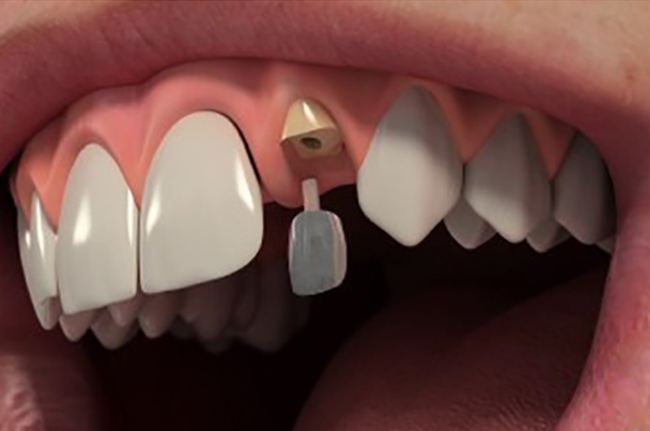
  • Involves uncovering the implant and attaching a pillar to each implant which will serve as the foundation on which the teeth will be placed.
  • Placement of the new teeth to suit individual needs to provide a natural appearance.

Teeth over these implants can be either fixed or removable depending on the individual needs. In both instances, the teeth will be fixed securely so as to enjoy everyday life without worry. It is also possible to permanently anchor small sections of missing teeth either in the front or the back.

One question looms large. How expensive is it? 
There are many options tailored to suit individual needs. Consumers are cautioned on the availability of cheap implants, sometimes indigenously manufactured, which have not been properly safety certified or documented for long term success. It is better to go in for reputed brands with a track record. The initial expenses may be marginally higher but the benefits far outweigh the costs. Your dentist can appraise you of all these.

To some people implants may sound cold and clinical. Scientific precision and advanced technology are however only the tools which touch the life of humans. From the tiny electronic chip to the man on the moon, somewhere in between is the dental implant seeking to give people a better life and making a bid for posterity as the single most significant dental advance in the past 200 years.

The time taken and the process is well worth it all.